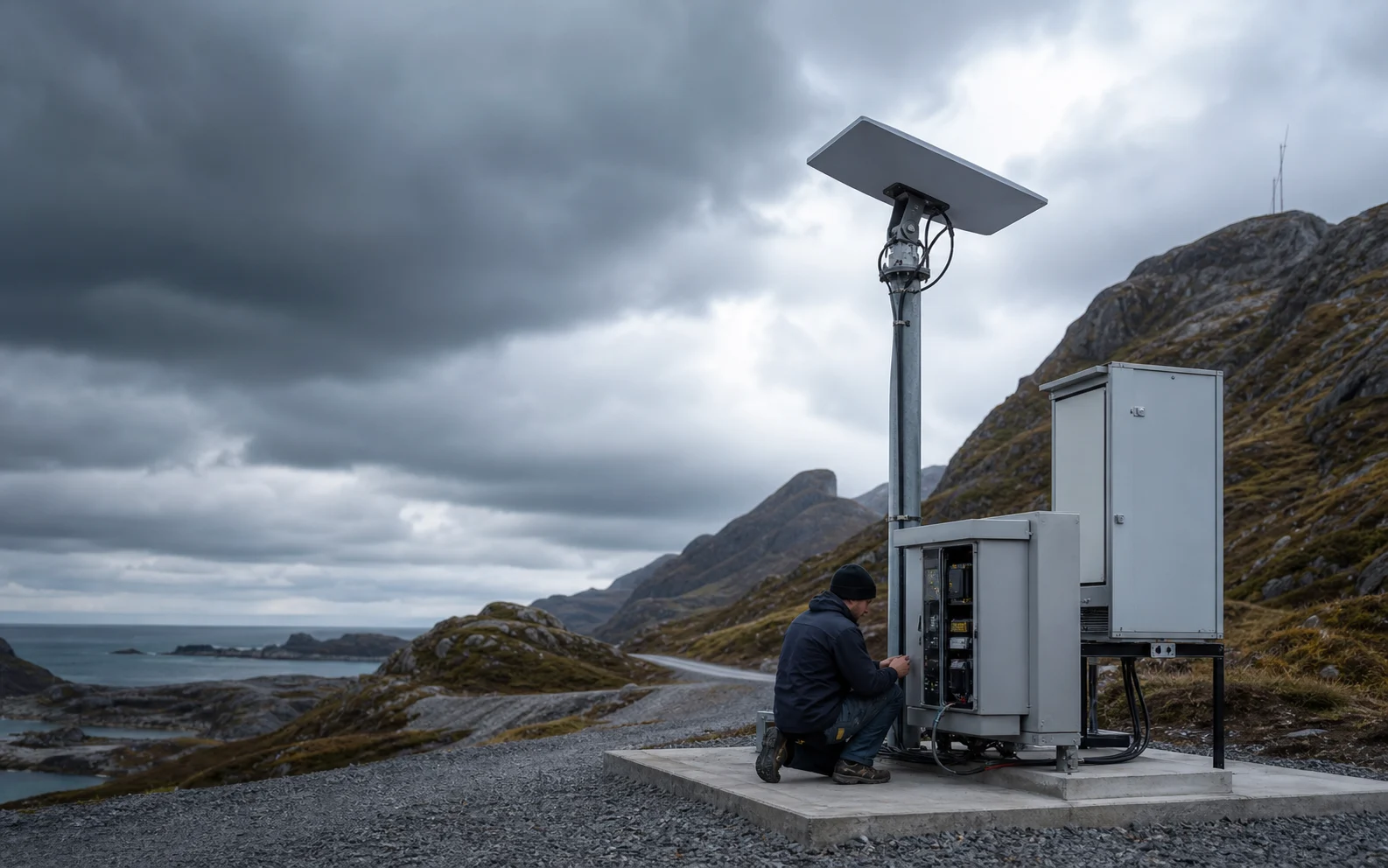
Satellite connectivity where conventional infrastructure stops.
LYNQNET qualifies, sources, and coordinates the complete connectivity environment—from satellite access and site infrastructure to local networks, deployment, and lifecycle ownership.
The same technology can be primary infrastructure, an independent continuity layer, or a temporary route to operations. That distinction changes every decision that follows.
ROLE
01
01 · Primary access
Create access beyond practical terrestrial reach.
For permanent sites where fiber, fixed wireless, or cellular service is unavailable, delayed, or operationally unsuitable.
Coverage and service eligibility
Application and capacity profile
Site, network, and support dependencies
First defined outputDefined primary-connectivity scope
Operational connectivity emerges when access, the physical site, the surrounding network, and lifecycle ownership are treated as one system.
01 · AccessService & terminalOrbital service path
02 · SiteMounting, power & protectionPhysical readiness
03 · NetworkEdge & local distributionPolicy and handoff
04 · OperationsMonitoring & lifecycleOwnership and support
System view · Live operational annotations
Architecture principle
Satellite may operate as the primary path, an independent backup, a rapid-deployment layer, or part of a hybrid network. The operating architecture—not a manufacturer logo—determines its role.
Deployment-ready connectivity scope
01
Service role & coverage
What must the connection accomplish—and where?
Confirm
Primary, backup, temporary, or mobile role; deployment region; visibility; capacity profile; service eligibility.
Defined output
A qualified access direction with open service assumptions stated.
A site-readiness brief and the dependencies surrounding the terminal.
03
Network integration
How does the access layer enter the operating network?
Confirm
Edge routing, failover logic, local wired and wireless access, traffic policy, security boundaries, monitoring, and acceptance.
Defined output
A defined integration scope with technical and partner responsibilities visible.
04
Commercial lifecycle
How will delivery, support, and change be owned?
Confirm
Quantities, variants, commercial basis, logistics, documentation, warranty route, service ownership, spares, and expansion.
Defined output
A commercial path with assumptions, boundaries, and unresolved conditions identified.
Project pathway
A visible route from requirement to operational ownership.
Five connected decisions keep technical, commercial, site, and partner workstreams aligned without obscuring responsibility.
01
Discover
Location, role, applications, constraints, quantity, and timing.
Operating brief
02
Qualify
Service fit, site conditions, architecture, and dependencies.
Solution direction
03
Structure
Products, quantities, terms, documentation, and delivery basis.
Commercial scope
04
Coordinate
Configuration, partners, logistics, readiness, and acceptance.
Deployment plan
05
Handover
Evidence, ownership, support route, and expansion decisions.
Operational ownership
Practical answers
Questions about satellite and remote connectivity.
The operating role, region, physical site, local network, commercial basis, and lifecycle model determine whether a satellite solution is suitable.
01
What is enterprise satellite connectivity?
Enterprise satellite connectivity uses satellite access as part of a complete business or infrastructure solution that also includes the terminal, mounting, power, local network, routing or failover behavior, deployment, monitoring, support, and lifecycle ownership.
02
When should satellite connectivity be used as primary access?
Satellite may be considered as primary access when practical terrestrial service is unavailable, delayed, geographically constrained, or unsuitable for the operating requirement. Coverage, capacity, service eligibility, site conditions, and application needs still require qualification.
03
How does satellite connectivity support business continuity?
A satellite path can provide an alternate route that is less dependent on the same terrestrial infrastructure as the primary connection. The value depends on power resilience, physical diversity, routing and failover logic, traffic priorities, monitoring, testing, and recovery ownership.
04
Does LYNQNET sell only one satellite technology?
No. LYNQNET is designed as a multi-vendor technology company. Satellite services and equipment are evaluated against the operating role, region, service eligibility, site, network architecture, commercial basis, availability, and support route.
05
What should a satellite connectivity request include?
Provide the deployment region, operating role, site count, applications, expected users or traffic, mobility, physical conditions, power, local network, target timing, support expectations, and any product or service decisions already made.