Routing and edge
Connect sites, upstream services, and application paths with the capacity, resilience, policy, and management model the environment requires.
Network Infrastructure
LYNQNET supports routing, switching, wireless, transport, and supporting infrastructure requirements for enterprise, service-provider, and project environments.
Designed as a system
Connectivity access alone does not determine the quality of a network. Routing, switching, wireless coverage, segmentation, optics, power, physical infrastructure, and management all influence the operating result.
LYNQNET helps customers and integrators connect those layers to a defined architecture, supply scope, and delivery plan.
Decision priorities
The bill of materials becomes useful only when the interfaces, supporting components, software conditions, physical environment, and responsibility boundaries are understood.
Connect sites, upstream services, and application paths with the capacity, resilience, policy, and management model the environment requires.
Support access, aggregation, core, branch, campus, industrial, and infrastructure roles with a coherent topology and lifecycle plan.
Design coverage, capacity, roaming, segmentation, mounting, and power around the users, devices, and physical environment.
Account for fiber, optics, media, interfaces, distances, upstream dependencies, and redundancy across the complete path.
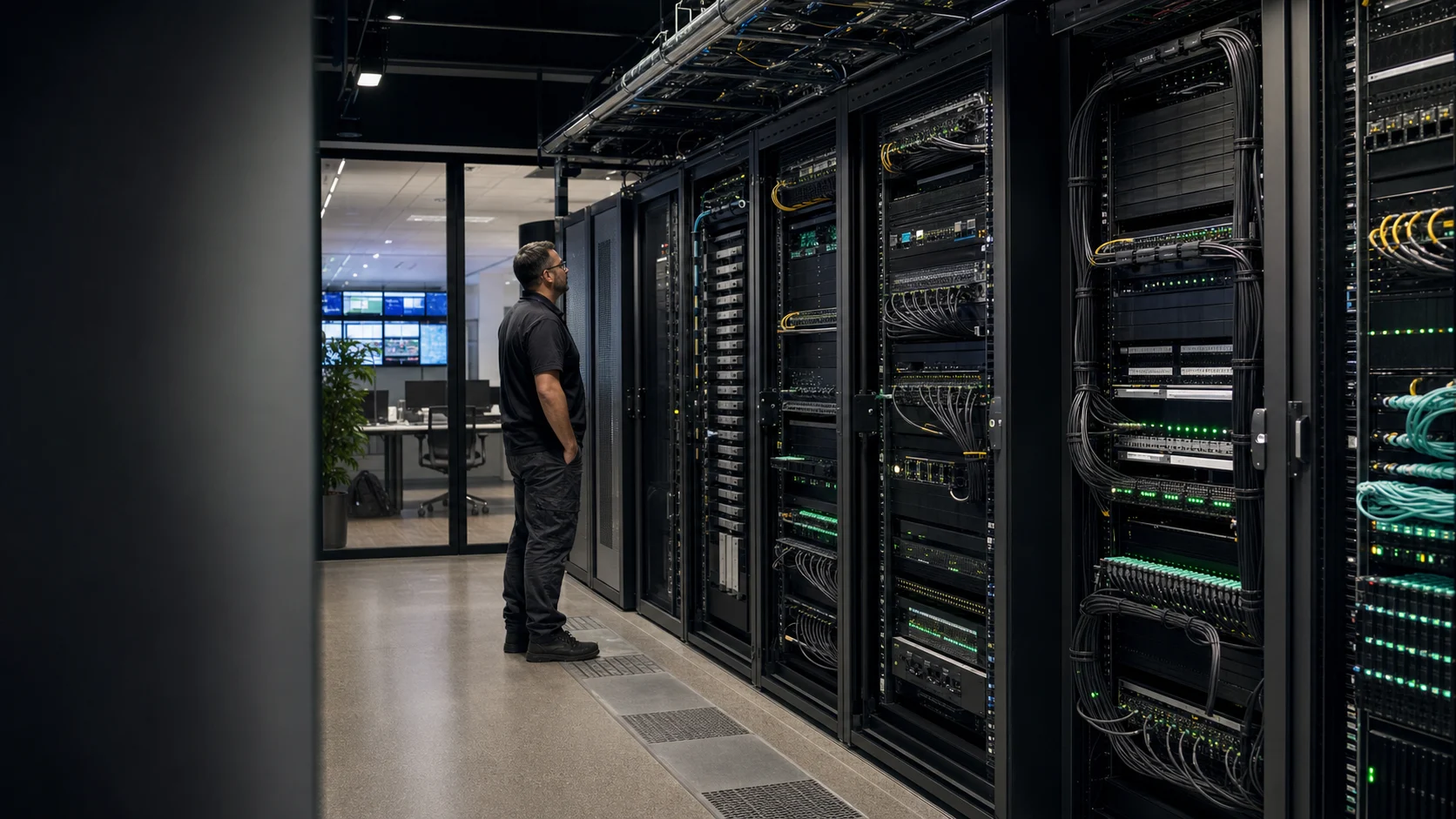
Treat racks, power, cabling, mounting, cooling, labeling, and access as part of the technical requirement—not accessories added later.
Infrastructure fabric
A robust design makes traffic paths, failure domains, capacity decisions, dependencies, and operational ownership visible before equipment is ordered.
External access, interconnection, optical paths, upstream services, and their commercial or regional constraints.
Routing, segmentation, policy enforcement, path control, and service dependencies at the boundary.
Capacity, redundancy, topology, uplinks, and lifecycle choices that shape the internal network fabric.
Switching, wireless, endpoints, power, monitoring, documentation, and the ownership model after deployment.
Where it applies
Infrastructure programs can begin with an aging platform, a capacity constraint, a new facility, or a defined bill of materials. The first task is to make the target state and migration conditions explicit.
Beyond the bill of materials
Compatibility, lifecycle, availability, accessories, software, documentation, and site conditions move through one controlled review.
Confirm environment, architecture, quantities, dependencies, markets, timing, and acceptance needs.
Qualified requirementReview compatibility, lifecycle, software or service conditions, optics, accessories, and regional fit.
Dependency registerAlign the proposed supply path, lead time, documentation, commercial terms, and responsibility basis.
Comparable supply scopeCoordinate staging, configuration, labeling, testing, and site-readiness responsibilities where included.
Implementation readinessConnect logistics, milestones, acceptance evidence, exceptions, and lifecycle ownership.
Controlled handoverExact engineering, configuration, security, licensing, installation, managed service, warranty, and support responsibilities are defined per project and may be delivered with qualified technology or implementation partners.
Practical answers
These answers define the normal starting point. Exact technology, delivery, specialist, and support responsibilities are confirmed for the individual project.
A network infrastructure scope may cover routing, switching, wireless, transport, optics, cabling context, racks, power, software or service dependencies, configuration, documentation, logistics, and acceptance responsibilities.
Yes. LYNQNET can review a defined bill of materials against quantities, variants, interfaces, accessories, lifecycle status, regional fit, software conditions, documentation, and the intended deployment environment.
No. LYNQNET is positioned as a multi-vendor technology company. Product and manufacturer relevance is evaluated against the confirmed architecture, supply basis, market, and project requirements.
No. Engineering, security, configuration, installation, licensing, managed service, warranty, and support ownership are explicitly assigned for each project and may involve qualified specialist partners.
Share the current or target architecture, locations, user and application needs, capacity, resilience, equipment list, preferred standards, deployment markets, timing, and known technical or commercial constraints.
A qualified first conversation
Share the current network, target architecture, bill of materials, modernization objective, deployment markets, or the constraint that needs to be resolved.
Discuss the requirement