Workload and response
Clarify what must run locally, the response time and availability required, the data involved, and the operating consequence of failure.
Edge & Data Center Infrastructure
LYNQNET supports technology sourcing and project coordination for distributed edge environments, network rooms, and selected data center infrastructure requirements.
Why edge matters
Local processing can support operational continuity, response time, bandwidth efficiency, data handling, or limited autonomy when upstream systems are constrained.
The appropriate architecture depends on the application, the physical site, connectivity, capacity, and the team that will operate the environment after deployment.
Decision priorities
Edge projects succeed when workload readiness and site readiness advance together. Equipment selection is only one part of that alignment.
Clarify what must run locally, the response time and availability required, the data involved, and the operating consequence of failure.
Confirm space, access, rack format, floor loading, dust, vibration, security, and maintenance conditions before selecting equipment.
Connect load, distribution, backup, cooling, airflow, monitoring, and recovery expectations to the actual site.
Plan upstream paths, internal switching, optics, segmentation, resilience, and bandwidth around the workload and location.
Define remote visibility, patching, support, spares, software, documentation, capacity change, and named ownership after handover.
Edge-to-core system
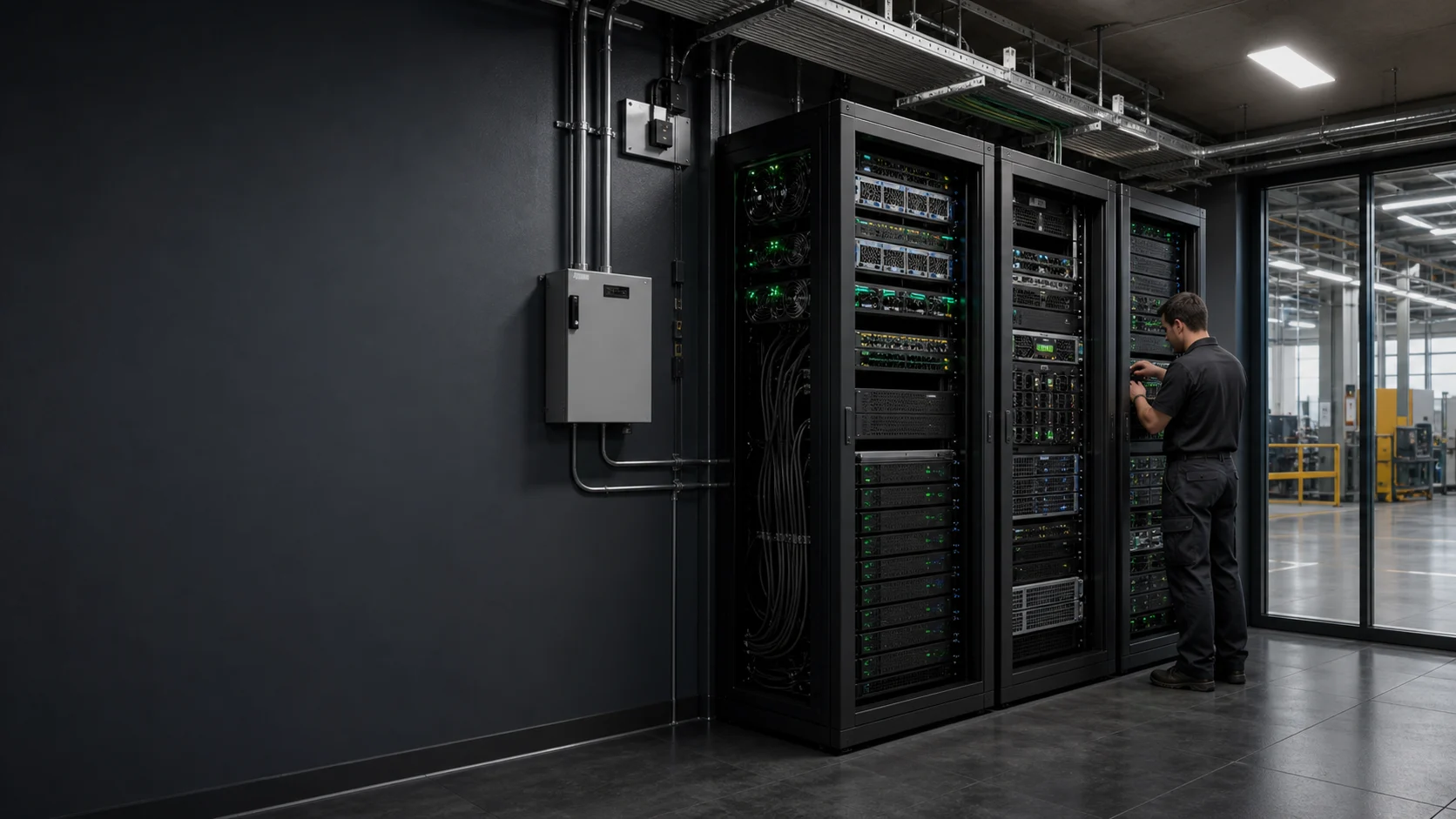
A distributed edge environment combines computing and network categories with the physical, power, thermal, security, and lifecycle conditions of the location.
Application behavior, data, response, continuity, scale, security, and local-processing requirements.
Categories selected around workload fit, form factor, lifecycle, service conditions, and the operating model.
Routing, switching, optics, upstream connectivity, segmentation, and resilient paths between edge and core.
Rack, cabling, power, thermal conditions, monitoring, access, maintenance, documentation, and lifecycle ownership.
Where it applies
Not every use case needs the same density or resilience. The pattern can range from a controlled network room to a compact, modular processing environment.
Two readiness tracks
Dependencies must converge before installation: the infrastructure cannot be ready without the site, and the site cannot be accepted without an owned technology plan.
Understand workload, users, data, site, capacity, availability, support, and schedule.
Requirement baselineConfirm space, power, thermal, access, security, connectivity, and maintenance dependencies.
Site-readiness viewAlign architecture, bill of materials, services, responsibilities, and acceptance conditions.
Coordinated scopeConnect sourcing, staging, configuration, documentation, logistics, and installation planning.
Deployment readinessRecord evidence, exceptions, handover, capacity baseline, and lifecycle ownership.
Operational handoverLYNQNET supports selected sourcing and coordination requirements. Workload engineering, data-center design, electrical, mechanical, fire, structural, security, installation, certification, and managed operations must be assigned to appropriately qualified parties for the confirmed scope.
Practical answers
These answers define the normal starting point. Exact technology, delivery, specialist, and support responsibilities are confirmed for the individual project.
Edge and data center infrastructure brings compute, storage, networking, interconnection, power, thermal conditions, physical protection, monitoring, and lifecycle ownership together around a workload and location.
Edge infrastructure is relevant when applications, data, users, equipment, latency, continuity, bandwidth, or local autonomy make processing closer to the operation more practical than relying only on a central environment.
Space, access, power, backup, cooling, network paths, security, mounting, maintenance, and local support can determine whether the proposed technology can be installed and operated as intended.
No. Workload, data-center, electrical, mechanical, structural, fire, security, installation, certification, and managed-operation responsibilities are confirmed separately and require appropriately qualified specialists where applicable.
Useful inputs include the workload, users, data, target response and availability, site conditions, current infrastructure, capacity, connectivity, support model, locations, and deployment schedule.
A qualified first conversation
Share the application context, environment, target capacity, locations, availability expectations, current infrastructure, and deployment schedule.
Discuss the requirement