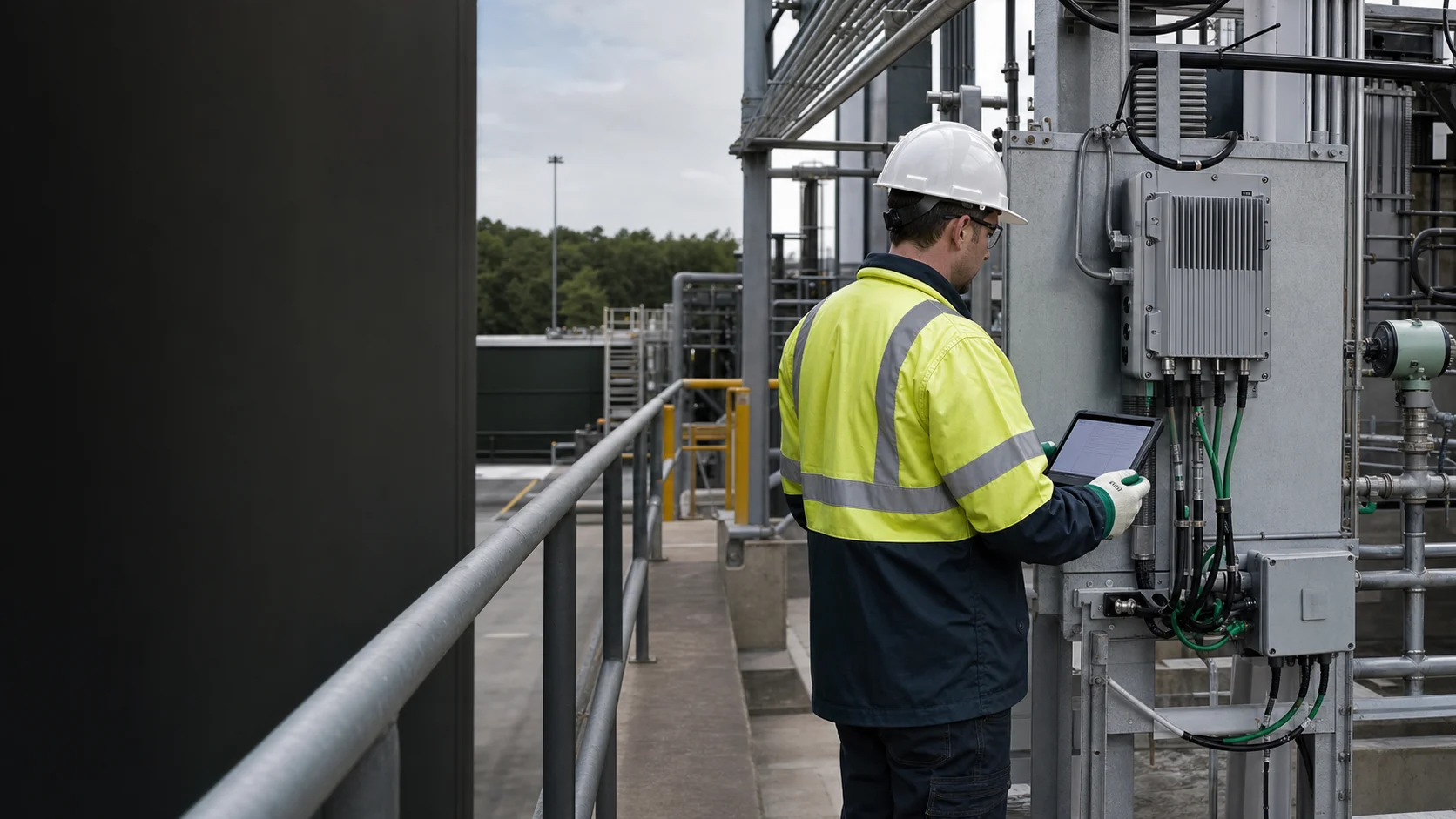
Environment
Temperature, dust, moisture, vibration, interference, access, mounting, and safety conditions shape what can be installed and maintained.
Industrial & IoT Connectivity
LYNQNET helps organizations and project partners evaluate connectivity for equipment, sensors, vehicles, and field environments where conventional enterprise networking may not be enough.
Operational context
Distance, interference, movement, power, environmental exposure, maintenance access, safety boundaries, and data criticality all influence the architecture.
LYNQNET begins with the operating conditions and the decision the data must support before evaluating technology categories.
Decision priorities
A technically capable component can still be unsuitable if its installation, power, environment, protocol, management, or support conditions do not match the operating reality.
Temperature, dust, moisture, vibration, interference, access, mounting, and safety conditions shape what can be installed and maintained.
Availability, quality, backup, consumption, remote cycling, and energy constraints influence every device and communications layer.
Coverage, movement, obstructions, handoff behavior, antenna position, and route diversity determine how assets stay connected.
Volume, latency, criticality, retention, local decisions, and the cost of interrupted data guide the edge and backhaul model.
Remote management, security boundaries, maintenance access, spares, field support, and lifecycle responsibilities must be explicit.
Device to decision
The useful architecture is the entire route from the connected asset through local infrastructure and edge processing to the people or applications that act on the information.
Sensors, controllers, equipment, vehicles, and the protocols or interfaces available at the operating edge.
Rugged switching, wireless or wired paths, segmentation, power, enclosures, and environmental protection.
Protocol handling, data preparation, local processing, buffering, and controlled connection between operational and enterprise domains.
Cellular, satellite, fixed wireless, or terrestrial access connected to the relevant platform, application, or operational team.
Where it applies
The requirement may be continuous monitoring, mobile operations, a temporary site, or a resilient alternate path. In every case, the environment defines the starting point.
Pilot-to-scale approach
Industrial environments reward a bounded, evidence-led path that exposes installation, coverage, power, protocol, and operational constraints early.
Document the asset, environment, data need, failure consequence, users, and operating boundaries.
Operating briefDefine field, local network, edge, power, backhaul, security, and management layers.
System directionCoordinate appropriate ruggedized and supporting technology around the confirmed conditions.
Qualified technology scopeValidate the important assumptions in a controlled site or limited deployment where required.
Evidence and exceptionsPrepare supply, logistics, installation, monitoring, support, and lifecycle for wider use.
Repeatable deployment modelLYNQNET does not imply responsibility for industrial control-system engineering, safety systems, regulated operational technology, or site certification. Exact engineering and implementation responsibilities require a confirmed scope and appropriately qualified specialists.
Practical answers
These answers define the normal starting point. Exact technology, delivery, specialist, and support responsibilities are confirmed for the individual project.
Industrial and IoT connectivity links equipment, sensors, vehicles, gateways, edge systems, and applications across environments where power, range, mobility, physical exposure, maintenance, and data consequence shape the design.
Depending on the environment, the path may combine industrial Ethernet, rugged wireless, cellular, satellite, fixed wireless, gateways, local edge processing, and an appropriate route into enterprise or cloud applications.
A bounded pilot can validate coverage, mounting, power, protocol behavior, environmental fit, data flow, remote management, and field support before a larger equipment or deployment commitment is made.
Not by default. Industrial control, regulated operational technology, functional safety, cybersecurity approval, site certification, and specialist engineering must be assigned to appropriately qualified parties for the confirmed scope.
Describe the assets, sites, physical conditions, mobility, power, interfaces, required data, users, failure consequence, deployment scale, maintenance model, and any safety or regulatory boundaries.
A qualified first conversation
Share the operating context, connected assets, data requirement, known constraints, locations, and the consequence if the communications path is unavailable.
Discuss the requirement